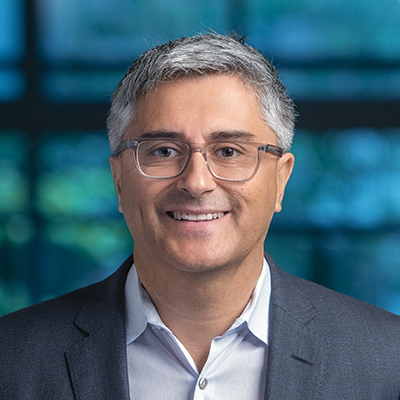
René Vidal
- Rachleff & PIK University Professor of ESE, Radiology, CIS, Statistics and Data Science
- School of Engineering & Applied Science, Perelman School of Medicine, Wharton School
- Director of the Center for Innovation in Data Engineering and Science (IDEAS)
- Co-Chair of PennAI
- University of Pennsylvania
Email: vidalr [at] seas.upenn.edu
Office: Amy Gutmann Hall, Room 609
Biography
René Vidal is the Rachleff and Penn Integrates Knowledge (PIK) University Professor of Electrical and Systems Engineering, Radiology, Computer and Information Science, and Statistics and Data Science at the University of Pennsylvania, with appointments in the School of Engineering and Applied Science, Perelman School of Medicine, and Wharton School. He is the Director of the Center for Innovation in Data Engineering and Science (IDEAS) and Co-Chair of PennAI. He is also the director of THEORINET, an NSF-Simons Collaboration on the Mathematical Foundations of Deep Learning, an Amazon Scholar, and an Affiliated Chief Scientist at NORCE.
His current research focuses on the foundations of deep learning and trustworthy AI and its applications in computer vision and biomedical data science.
Honors & Awards
- ACM Fellow
- AIMBE Fellow
- IEEE Fellow
- IAPR Fellow
- Sloan Fellow
- IEEE Edward J. McCluskey Technical Achievement Award
- D'Alembert Faculty Award
- J.K. Aggarwal Prize
- ONR Young Investigator Award
- NSF CAREER Award
- Best paper awards in machine learning, computer vision, controls, and medical robotics
News
- 2025 Announced Penn AI Council.
Prospective Students
Prospective students interested in joining the group are welcome to get in touch by email. When reaching out, please use a subject line containing the phrase "Prospective Student – [Your Name]" so your message is properly identified.
In your email, include a brief introduction, your current degree program and institution, and a concise description of your research interests and how they align with the group's work. Attaching your CV and any relevant publications or projects is helpful.
Students with strong backgrounds in mathematics, statistics, or computer science—and an interest in theoretical and applied aspects of machine learning—are particularly encouraged to apply. Qualified applicants may be considered for research assistantships or graduate positions through the department's programs.